(Reprinted from The Christian Index: https://christianindex.org/stories/commentary-four-cs-of-the-cooperative-program,63306)
To put myself through seminary, like many a financially struggling student, my wife and I had to find odd jobs. The Lord opened the door for me to work at a local jewelry store in the Crabtree Valley Mall for about 30 hours per week. It was there that I really learned to appreciate diamonds. From the time I offered a diamond engagement ring, I had known that a diamond was a pretty stone. But during my tenure as a diamond specialist, I learned that four C’s mark the worth of that little rock: the cut of the stone, the clarity inside, the color it yielded, and the total carat weight.
Like my introduction to the precious nature of diamonds, I have learned that our Southern Baptist Cooperative Program for missional giving also has some theological reflections that dignify its worth. Of course, since 1925 the CP has been an effective way to consolidate missions giving for the convention so that one missions cause isn’t left at a disadvantage. But the CP can also be appreciated for four thoughts that begin with the letter C.
The first C is Community. When Jesus commissioned His disciples in Matthew 28:18-20, he didn’t pick out just a few of them to be missionaries. He called them all. The use of the second person plural in His command to make disciples signified His expectation for them all to be on mission as they would be going. In fact, perhaps a better modern translation of the passage might read, “Go ya’ll therefore and make disciples of all nations.” Kudos to the southern colloquial in helping us understand the plural of you. There is truly joy in being in community both in our going and in our returning to celebrate missions. I personally can testify the humbling elation of meeting other Southern Baptists I’ve never known and thanking them for their Cooperative Program giving that allowed me to be their missionary.
The second C is Commission. Jesus was clear in Matthew 28:19 that every ethnicity was to be reached with the gospel and made into disciples of Christ. Clarifying further in Acts 1:8, His continuation of the discourse right before His ascension affixed four mission fields. For the 120 disciples listening to Jesus, they heard the locations named Jerusalem, Judea, Samaria, and the uttermost parts of the earth. That commission designated a local field, a regional field, a national field, and international fields. The beauty of the Cooperative Program is that it holistically addresses all fields by allowing our giving to support joint works locally as monies are pooled to strengthen local churches throughout the state. In Georgia, it targets the most unchurched zip codes in each region by supporting joint evangelistic efforts and new church starts. It supports the North American Mission Board’s work across this continent to plant new churches in key cities. It also finances the mission work of international missionaries through our International Mission Board.
Comprehensive is the third C. Just as missions is more than a mere trip, missional giving must support the holistic missional engagement of the world. In Matthew 28:19-20, Jesus explained that making disciples would entail evangelism resulting in baptisms and discipleship resulting in spiritually mature leaders who follow Jesus’ commands. We rejoice with each report of new baptisms throughout Georgia, America, and around the world. We praise the Lord when we hear of new small groups and new churches planted in places where there were none. And in gratitude when He raises up new ministers and missionaries, we support ministry training in seminaries through our Cooperative Program gifts.
The fourth C is Continuity. The beauty of Jesus’ Great Commission for the church was that He was not leaving them to the work alone, but He promised in Matthew 28:20 that He would personally be with them until the end of the age. This promise based on His complete Authority in verse 18 is guaranteed with His complete Presence in verse 20. The longevity of missions must be fueled by a pipeline of missionaries for the future until He returns to close this age. The supply for missions must be resourced, and the advocacy of missions must be voiced. Our Cooperative Program allows us to do both to ensure a future support system for all of those who will one day be our missionaries.
While some may speak of abandoning missions praying, giving, or going, we should issue yet a greater call for the diamond status of our joint missions efforts. As beautiful as missions can be, it is even more precious when we see our cooperative work theologically reflect a community commissioned and comprehensively supplying the resources with continuity for the future. May our joint missions work be as precious to us as diamonds.
Click below for FREE downloads of Bible Book Studies in daily devotional format. Feel free to copy and distribute, or use them for sermon starters or prayer meeting intros.
With a history of trials, Georgia Baptists have been a missional people. Over six major eras, Georgia Baptists have made missions a priority.
At their earliest arrival into Georgia as a penal colony in 1733, men and women who identified themselves as Baptists sought to establish churches as starting points for evangelistic outreach. In The Baptist Heritage: Four Centuries of Baptist Witness, Leon McBeth notes that Baptist missional efforts began in Georgia in 1773, and the first Baptist association was formed in 1784 with “plans to sponsor statewide mission work” (224). According to Robert Torbet in A History of the Baptists, in 1783 an emancipated slave named George Liele became the first ordained Baptist African American and the first Georgia missionary to carry the gospel to a foreign field. In his A History of the Georgia Baptist Convention 1822-1972, James Lester observes that “mission interests were strong in the area of the Georgia association prior to formal associational organization” (40). In fact, “there is ample justification for the statement that when early Georgia Baptists began to think collectively about mission work, white and black were thinking in terms, primarily, of a mission witness to the Indians at this point in history, prior to the beginning of the mission efforts evident by 1813” (Lester 44). However, believers in 1813 formed a “Baptist foreign mission society in Savannah [as the] first Georgia associational organization for missionary purposes.” (Lester 787).
From this point, other missionary societies began to develop on the national and state levels. In The Southern Baptist Convention and Its People 1607-1972, Robert Baker notes that “the national missionary body in 1814 [grew] out of the conversion of the Judsons and Rice” (131). Other local missionary societies arose in Georgia, and “it is likely that the missionary work among the Creeks and Cherokees beginning about 1819 was the outgrowth of this missionary spirit” (Baker 132). The primary method for missional outreach was the establishment of sabbath schools as teaching arms in church planting across the state within regional associations.
The second major era of missions growth began when Georgia Baptist associations formally organized in 1822 as the General Baptist Association of the State of Georgia by resolution of Adiel Sherwood. In 1827, the group was officially renamed as the Baptist Convention for the State of Georgia. Some of the missional highlights in these earliest days of the convention was proactive missions to the Creek and Cherokee Indians in the 1830s, the 1835 convention commitment “to raise $3000 of a $100,000 goal for missionary purposes set up by the United States Baptist Convention for Foreign Missions” (Lester 109), and an article in the Christian Index in 1840 calling for a “Southern society” to make sure that funds for the “Texian mission” would be sufficient (Baker 154). In Road to Augusta, author Joe Burton surmises that an “antimissions spirit had been preached up and down the hills and valleys” (52), but Georgia Baptists fought this demonic spirit with an evangelistic fervor. There seemed to be a growing consensus across the United States during these years to unite in missional outreach toward the frontiers of the west and for the most needy in the rural South.
The third historical era began on May 8, 1845, at First Baptist Church in Augusta, when 293 people convened in Georgia to establish a new national convention with two separate mission boards for home and foreign missions. W.W. Barnes notes in The Southern Baptist Convention 1845-1953 that 139 Georgia Baptists made up almost half of the delegates. McBeth notes that the year brought an end to unity among Baptists in America as the Southern Baptist Convention was born (391). But Georgia Baptists doubled down by supporting William Tryon, a Georgia Baptist pastor, to push Indian missions in Texas as well as to support missionaries to Africa and Burma. In 1871, Georgia had adopted child-care ministry for orphan children as a missional effort. On July 7, 1873, the Foreign Mission Board appointed Charlotte D. “Lottie” Moon to China. Through a missions sermon in her home church in Cartersville, Georgia, Moon had clearly heard the Lord’s call to go. Over the next forty years, Lottie Moon’s missions involvement inspired more Southern Baptists to give and go to various mission fields. That was the same year that J.M. Wood formed a committee to call for a state board of missions. According to B.D. Ragsdale in Story of Georgia Baptists Vol 3, in 1876 J.G. Ryals made the formal recommendation and J.H. Campbell made the 1877 resolution to the state convention.
In order to curb the extravagant expense of raising money for national and international missions efforts and to ensure missions would continue to reach the neediest in the state, Georgia constituted the “Board of Missions of the Baptist Convention of Georgia” in 1877 with instructions to the home and foreign boards to work through this new entity to raise mission money in Georgia. This brought in the fourth era. Even though theological and missiological controversies had permeated Baptist churches and threatened the foreign missions arm of the Southern Baptist Convention, Georgia Baptists wanted to reach more at home and abroad. The heavy influx of immigration into America by the end of the 19th century caused Georgia Baptists to place a missional emphasis on reaching the foreigners arriving at their doorsteps. Moreover, concerted efforts to reach indigenous people within the state grew to a top priority. With missions giving growing among Georgia Baptists, they were committed to missions work to thousands of freedmen who had left “white churches to form their own.” (McBeth 404). By this time Georgia had already partnered with other states to support missionaries to Mexico, Brazil, Japan and Italy. Even though informal ties remained on missional fronts between the North and the South with the American Baptist Publication Society and the American Baptist Home Mission Society, “the last organizational tie between Baptist churches North and South was thus severed” (McBeth 401) in 1897 with the dissolution of fellowship between the missions efforts of the two societies. In 1903, First Baptist Church of Macon financed the very first Southern Baptist mission hospital in China.
The Georgia Baptist Board of Missions remained in existence until 1919. That year, the beginning of a fifth era, the Georgia Baptist Convention voted to reconstitute its leadership as an executive committee to model the recent national change and to ensure efficiency in application of missions funds. By 1920 a pandemic infected one-third of the world’s population at the time and killed up to 100 million people. Accordingly, Georgia Baptists turned their missional interests toward offering medical aid to orphan homes in Georgia, and the survival rate among those children was remarkable.
Initially inspired by the attempted $75 million campaign to raise funds in a unified manner, the Cooperative Program was born in 1925 to diminish the inefficiency of societal giving and form a unified missions fund for Southern Baptists. This “one sacred effort” to pool missions giving continued to grow through the twentieth century. Because missions funding was secure, international missions efforts grew from 908 missionaries in 33 countries in 1953 to over 5,000 missionaries in almost 200 countries in 2001. This growth culminated with hundreds of Georgia Baptists deployed as full-time missionaries to various parts of the world to help reach the unreached and with thousands of Georgia Baptist volunteers traveling each year to join the work, not only in their giving but in their going. IMB president Paul Chitwood applauds Georgia Baptists as some of “IMB’s strongest partnering and most generous churches, [as] thousands of volunteers come to the mission field to serve alongside their IMB missionaries and millions of dollars flow from Georgia Baptist Convention churches to support those missionaries.” Currently, IMB has 294 current Field Personnel with ties to Georgia.
A new era began in 2015, and the Georgia Baptist executive committee approved a proposal to allow for the DBA designation of a new Georgia Baptist Mission Board with its renewed missional emphasis throughout the state. Under the leadership of current executive director W. Thomas Hammond, Jr., six geographic regions of the state were drawn in 2019 with opportunities for Georgia Baptist churches to engage locally, regionally, nationally and internationally through supported partnerships with Association Missions Strategists and SBC partners in most lost zip codes, other state conventions, and countries in Central and South America. The idea of missional partnerships as a means to strengthen churches complemented the stated priority of Georgia as a viable mission field.
Georgia has always had a presence of Baptists who care enough about the Lord’s Great Commission that it has weathered storms of philosophical controversies, endured physical and financial hardships, and remained committed to the command to make disciples at home and abroad. Georgia truly is our mission field, and yet it is still a launching pad for sending missionaries. Baptists in Georgia started with missions to this state, and missions continue through Georgia Baptist churches to reach the lost everywhere. May the Lord be praised for His calling His people to be on mission to and through this state for over 200 years.
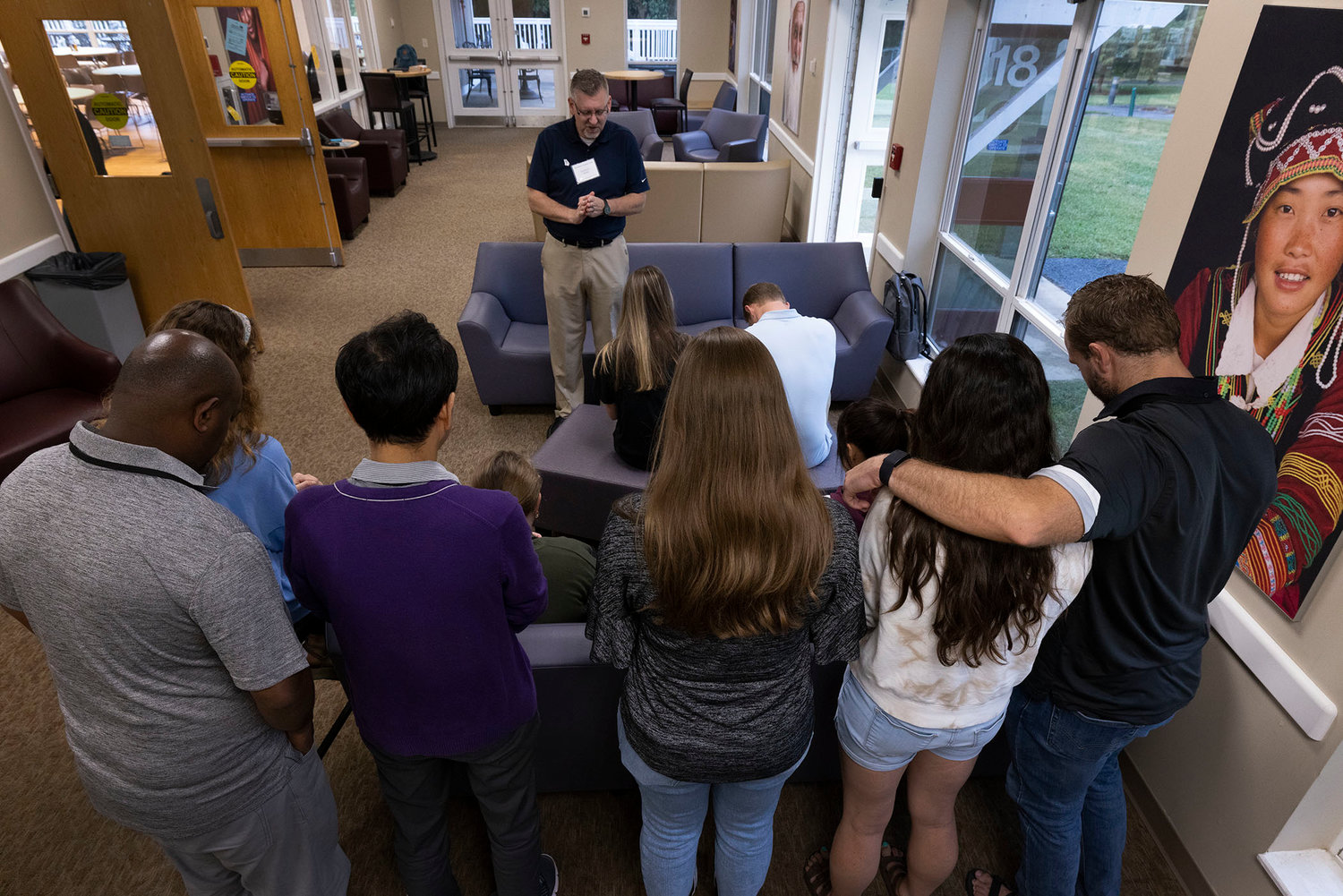
Buck Burch, State Missions Catalyst for the Georgia Baptist Mission Board, prays over the IMB group as they gather at the International Learning Center in Richmond, Va. (Photo/International Mission Board)
In a remote location outside of Richmond, Va., missionaries appointed with the International Mission Board undergo a season of training before embarking on their first term of mission service.
Within the next three years, IMB hopes to have increased its missionary force by an additional 500 personnel carrying the gospel to some of the least reached people in the world. Just prior to leaving American soil, these will come through this International Learning Center, and many of these will come from Georgia Baptist churches.
My family and I had the opportunity to go to the learning center almost 25 years ago after we were appointed as international missionaries. I still remember having strong connections to several churches in Georgia at that time, but there were so many more we would come to know as we represented Southern Baptists as a whole.
This week I was able to share a visit with a new crop of fourteen missionaries at the center, and I heard them wonderfully relate how God has called them to go into all the world from Georgia. As I prayed with them before their departure, I reminded them that Georgia Baptist churches are continuing their commitment to financially support them through the Cooperative Program and the Lottie Moon Christmas Offering.
I also assured them that Georgia Baptist churches would be praying for them even if they might not be able to know all of their names. Some will have to remain anonymous due to security protocols in their countries of service. These missionaries expressed gratefulness to Georgia Baptists for praying for, giving to, and sending them from their home state. It’s good to be a Southern Baptist missionary; it’s great to be a Georgia Baptist missionary.
IMB has expressed gratitude for the many ways Georgia Baptists pray, give, go and send to the nations—and that includes connecting churches to missionaries through partnerships, providing opportunities to meet missionaries by hosting sending celebrations, and by visiting with field personnel as part of their orientation in Richmond.
According to Terry Sharp, IMB’s Convention and Network Relations Leader, “IMB leadership estimates that almost 50% of Southern Baptist churches have no known connection to an IMB missionary.”
It is extremely important that Georgia Baptists find a way to connect with our IMB missionaries from our home state. Some will experience difficult times on the field, and they will need our prayer support. Many will need the Christian fellowship that our Georgia Baptist churches can offer through short-term mission trips and care packages. Many have found creative ways to connect privately through social media in addition to traditional prayer cards and newsletters.
In two to four years, some of these from this week will return to Georgia and will be ready to share all of the wonderful things God is doing around the world. “Church Connections was recently introduced to remedy this gap in relationships and directly connect IMB missionaries to Southern Baptist churches,” says Sharp.
Paul Chitwood, president of IMB, has said, “To live out our mission statement that the IMB ‘exists to serve Southern Baptists in carrying out the Great Commission to make disciples of all nations,’ we must prioritize our relationships with churches. The Church Connections initiative allows us to do just that by building sustained, ongoing relationships so that every Southern Baptist church is connected with at least one IMB missionary.”
Our Georgia Baptist churches can prepare in advance to receive them, love on them, and double down on a supportive commitment as they come back stateside. As a part of the 200th anniversary celebration of the Georgia Baptist Convention, on Sunday evening, Nov. 13, 2022, at Warren Baptist Church in Augusta, Ga., the Georgia Baptist Mission Board will host an IMB Sending Celebration for many new international missionaries being commissioned.
That would be a great time to begin a connection with some missionaries who may call Georgia home. More information can be found at gbc200.com.
Emerging from the shutdowns and quarantines of the pandemic, Georgia Baptists are continuing to get back into the swing of international missions with vision trips and mission trips. Each of the six regions is focused on local, national, and international partnerships. This has allowed churches to exponentially increase their impact and multiply their efforts. Acts 1:8 teaches a holistic approach to missional engagement with every church adopting a local mission field (Jerusalem), a regional field (Judea), a national one (Samaria), and an international focus (uttermost parts).
Here are a few updates on the missions efforts taking place across the state and nation:
ZIP Codes with the Most Unsaved Residents
In the northern regions of Georgia, Cumming and Lawrenceville are the two ZIP codes with the most unsaved residents. Multiple evangelistic events in both cities are happening this year, with associational and local church leadership as well as virtual strategy coordinators offering their expertise.
Central cities, Augusta and Stockbridge, have been receiving mission teams from regional churches and other parts of the state. In the South region, Columbus and Savannah have “Crossover” events on the calendar for one-day, high-impact missional, and evangelistic activities.
State Convention Partnerships
Georgia has partnerships with other state conventions for mission trips. Vision trips have already been taken to Utah/Idaho, Pennsylvania/South New Jersey, New England states, Puerto Rico and New York. In some cases, pastors and virtual strategy coordinators have returned from their trips to see an increase in the number of people who want to go with them on the next trips. Some of those state conventions have also provided local mission team support for housing and transportation, and at least one vision trip has resulted in a Georgia Baptist pastor relocating to that state as a missionary. A vision trip to Michigan for the East Central region is being planned for May to connect with both church planters and existing churches.
As a new pastor seeking to build a comprehensive missions strategy, Keith Ivey and the GBMB was the exact resource we needed to help mobilize our church in an Acts 1:8 way! With their guidance we connected with immediate opportunities. Our people are so excited to see what God’s going to do!
– Kyle Walker, Pastor First Baptist Church, Cartersville
International Missions
Georgia Baptists are also making an impact in Central and South America, in conjunction with IMB and other Great Commission Christians in Guatemala, Nicaragua, Ecuador, Colombia, Peru, and Argentina. Several vision trips were undertaken at the end of 2021, and there are several more being planned this spring and summer. Construction projects and meeting human needs are high priorities, and a partnership with Renew World Outreach has also supplied technology for evangelism advancement in remote locations.
A partnership with Pastor-to-Pastor training is also delivering practical theological training to indigenous pastors who otherwise receive none, and in some cases with national Baptist seminary certification. A new partnership with a missions volunteer agency can provide low-cost logistical support for Georgia Baptist churches in those countries.